|
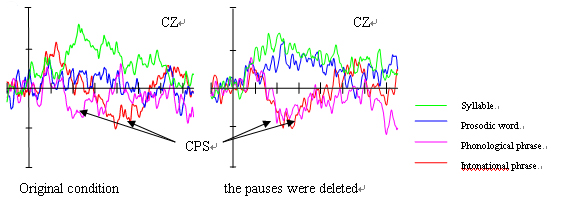
We hardly imagine what will be like if every word is spoken with the same speed and pause duration. Prosodic boundary (namely pause), and in particular somewhat bigger ones like phonological and intonational phrase boundaries, is very important in our daily communication. Especially for the ambiguous sentence, meaning of a sentence with the same word and syntax will be extremely different when we pause in different places. The advent of new methods such as ERPs made a new ERP component (the CPS, closure positive shift) which was assumed primarily to reflect the closure of intonational phrases was found. It has been well known that there are other prosodic hierarchy (e.g., prosodic words and phonological phrases) in sentence prosody, and the acoustic-phonetic cues of their boundaries are similar but change systematically in quantities. One of the most recent studies conducted by Weijun Li and Yufang Yang (State Key Laboratory of Brain and Cognitive Science, Institute of Psychology, Chinese Academy of Sciences) explored whether prosodic boundaries at different levels could evoke the CPS, and its relation to acoustic cues using ERP technology. The result replicated the same effect as the research conducted using Indo-European language, which suggests that the CPS was a universal component occurred in various languages. More importantly, it was found that phonological phrases which were lower in prosodic hierarchy also evoked this special component. The promising facet is that the onset latency for the CPS elicited by phonological phrases was a little earlier and the amplitude was somewhat lower as compared to the one evoked by intonational phrases. However, when we carefully removed the silence in the vicinity of the two phrases, ERP results showed that the CPS onset latency difference in the former experiment disappeared, and the amplitude in the new conditions was also lower in some degree. All these indicated that although pause was not the decisive factor to evoke the CPS, it can modify this component. Our study indicates that whenever listeners perceive a prosodic break, the CPS will be elicited, no matter what prosodic hierarchy it belongs to. Present results extend the condition of the CPS elicitation, and thus deepen our understanding of it.
This study was supported by the National Natural Science Foundation of China (30370481) and the Foundation of State Key Laboratory of Brain and Cognitive Science (The cognitive significance of the closure positive shift and its related prosodic cues.)
Weijun Li, Yufang Yang*. Perception of Prosodic Hierarchical Boundaries in Mandarin Chinese Sentences. Neuroscience.
|