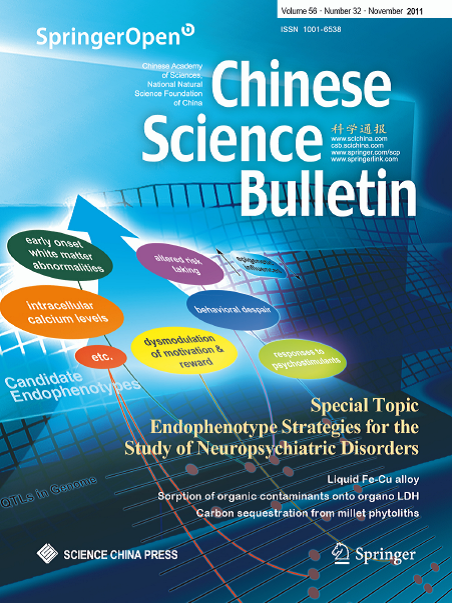
The study of endophenotype is of particular useful for us to understand the underlying mechanism of the illness process of neuropsychiatric disorders, aiding the clinicians to make accurate diagnosis and for early detection purposes. In the special issue of Chinese Science Bulletin, 2011, Vol. 56(32), a forum is specifically aimed to address the cutting-edge research in endophenotype for neuropsychiatric disorders. It provides theoretical and clinical strategies for neuropsychiatric disorders research.
The identification of genes that contribute to a susceptibility to complex neuropsychiatric disorders such as schizophrenia, major depression and bipolar disorders has been not very successful using conventional genetic approach. There are several problems associating with this conventional approach including carriers of genes cannot be identified in the absence of manifest symptoms and the heterogeneity of neuropsychiatric disorders. A new direction that appears encouraging is the identification of neurobiological or neurobehavioural characteristics associated with these complex neuropsychiatric disorders, or endophenotypes, that may be more closely linked to gene expression. Endophenotype is a biomarker associating with genetic components as well as the clinical symptoms of neuropsychiatric disorders. It plays an important role to bridge the gap between microscopic level and macroscopic level of neuropsychiatric disorders. The identification of endophenotype, along with the advanced genetic analysis such genomewise association studies, is very crucial to the identification of genes that predispose someone to neuropsychiatric disorders. Therefore, the study of endophenotype is of particular useful for us to understand the underlying mechanism of the illness process of neuropsychiatric disorders, aiding the clinicians to make accurate diagnosis and for early detection purposes.
With the supported from the National Basic Research Programme of China (973 Progamme) (2007CB512302), The Key Laboratory of Mental Health of the Institute of Psychology, Chinese Academy of Sciences has organized a strategic symposium for endophenotypes, titled “Endophenotype strategy for psychotic disorders and summit meeting of Key Laboratory of Mental Health, Institute of Psychology, CAS”. International renowned scholars of this field presented their updated findings on endophenotypes. Professor Irving Gottesman, the founder of the endophenotype for neuropsychiatric disorders, was also giving a video lecture to all the participants. Their work was published in the special issue of Chinese Science Bulletin, 2011, Vol. 56(32).
In particular, Dr. Raymond Chan from the Neuropsychology and Applied Cognitive Neuroscience Laboratory, the Key Laboratory of Mental Health, Institute of Psychology, made a strategic paper on endophenotypes and argued the need for establishing a central consortium for neuropsychiatric disorders in mainland China, namely the Consortium for the Human Information and Neurocognitive Endophenotype (CHINE). The CHINE is intentionally established to pave the roadmap for neuropsychiatric disorders research. It not only identifies the biosignatures for neuropsychiatric disorders but also serves as the central databank for examining the etiologies of major complex neuropsychiatric disorders as well as serving as the main basis for corresponding treatment development. The CHINE emphasizes on two main features, i.e., the supposedly universal basic cognitive functioning such as attention, and the supposedly culturally specific social cognitive functioning such as emotion perception and expression. In this consortium, data collected highlights the genetic level (susceptibility genes associating with major neuropsychiatric disorders, neuroanatomical level (structural and functional imaging data), and behavioural level (neurocognitive function performances, social cognitive functioning, neurological and clinical manifestations). Target groups include both the clinically diagnosed patients suffering from neuropsychiatric disorders (mainly schizophrenia and bipolar disorders at the current moment, but will be extended to other clinical groups later), non-psychotic first-degree relatives of the patients, and healthy controls. Dr. Raymond Chan specifically illustrated an example of a promising endophenotype for schizophrenia, namely neurological soft signs, in detailing the steps for building the consortium. It is also noteworthy that the potential translational usage of neurological soft signs as a quick, quantifiable, sensitive and user-friendly bedside early detection and screening tool for clinical practice.