Major depressive disorder (MDD) is characterized by abnormalities in emotional processing which operates both on a conscious and an unconscious mode. Previous studies on MDD have focused on abnormalities of conscious emotional regulation, however it remains unclear whether MDD shows also deficits in the unconsciously processing either positive or negative emotions. Dr. Zhi Yang and his colleagues in Institute of Psychology, CAS and in Shanghai Mental Health Center conducted a study with both healthy and MDD subjects to investigate unconscious emotional processing and its valence-specific alterations.
With a continuous flash suppression paradigm, they presented faces expressing emotion of positive and negative valences to one eye of the subjects. The other eye of the subjects viewed high-contrast flashing color patches so that the subject could not realize the emotional faces. After 800 ms, Gabor patches were displayed to both eyes to detect the attentional preference evoked by the invisible emotional facial expression.
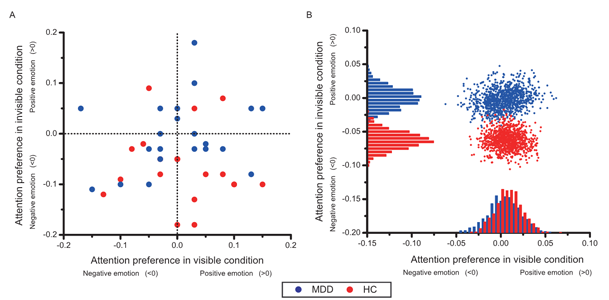
The study found that healthy subjects showed an attentional bias for negative emotions in the unconscious condition, while this valence bias were absent in MDD patients. This attentional bias tended to be diminished in the conscious condition for both healthy subjects and MDD patients. The findings suggest the valence-specific deficits in unconscious processing of emotions in MDD might be significant for future subsequent neurobiological investigations as well as for clinical diagnosis and therapy.
 |
|
Figure. Attentional preference to postive and negative emotions in visible and invisible conditions. |
(A) Scatter plots of invidiual attention preference in MDD (blue) and healthy controls (HC, red). The horizontal axis presents attentional preference in visible (conscious) condition. Positive and negative values correspond to positive and negative emotional valence. The vertical axis indicates attentional preference in invisible condition. (B) Bootstrapp results for the two subject groups. The HC group shows negative attentional preference in the invisible condition (vertical axis), while the MDD group does not show such trend. The two populations are clearly separated in this measure.
Reference
Yang Z, Zhao J, Jiang Y, Li C, Wang J, Weng X, and Northoff G (2011). Altered negative Unconscious processing in major depressive disorder: An exploratory neuropsychological study. PLoS One 6, e21881.