Fearful faces convey signals of potential threat and recognizing such facial expressions with precision in conspecifics is evolutionarily advantageous. Within the human brain, the amygdala is presumed to play an essential role in processing such facial expressions. Selective recognition deficits for fearful facial expressions were observed in humans with amygdala lesions. Our results indicated that there exist associations between amygdala volume and performance in fearful face recognition.
Thirty normal adults were recruited and each completed two identical facial expression recognition tests offline and two magnetic resonance imaging (MRI) scans. Linear regression indicated that the left amygdala volume negatively correlated with the accuracy of recognizing fearful facial expressions and positively correlated with the probability of misrecognizing fear as surprise (Figure 1). Further exploratory analyses revealed that this relationship did not exist for any other subcortical or cortical regions. Nor did such a relationship exist between the left amygdala volume and performance recognizing the other five facial expressions.
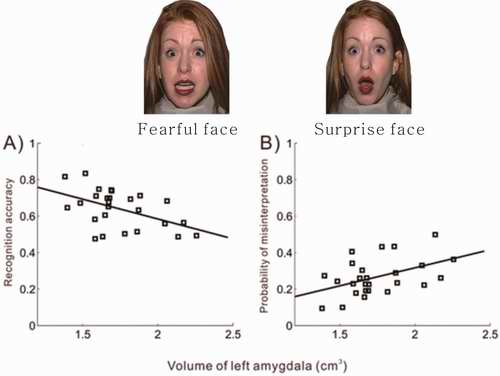
Figure 1. The left amygdala volume was negatively correlated with the accuracy for recognizing fearful faces (A) and positively correlated with the error rates for judging fear as surprise (B).
These results provide insights regarding inter-individual differences in sensitivity toward fear-relevant stimuli, and provide also a new perspective on patients stricken with spider phobia, posttraumatic stress disorder (PTSD), or pediatric anxiety (particularly social phobia) whose amygdala volume differ from normal people.
This research was supported in part by grants from 973 Program (No. 2011CB302201) and the National Natural Science Foundation of China (Nos. 61075042, 81171409, 81220108014).
Zhao, K., Yan, W. J., Chen, Y. H., Zuo, X. N., & Fu, X. (2013). Amygdala Volume Predicts Inter-Individual Differences in Fearful Face Recognition. PLOS ONE, 8(8), e74096.