|
Human brain electroencephalogram (EEG) has been assorted into several kinds by different frequencies, such as: Delta power, Theta power, Alpha power, Beta power and Gamma power. Delta power and Theta power belongs to low-frequency power, and Beta power and Gamma power belongs to high-frequency power. Some research report that Theta power correlates closely with episodic memory and working memory performances (Klimesch, 1996).
Time-frequency analysis technique separates different event-related frequency activities and also helps to differentiate frequency channels in specific time courses of perceptual and cognitive processing (Basar and Stampfer, 1985). It has been reported that event-related Delta activity relates to neural processing of signal matching, and Theta activity reflects neural processing of focused attention (Basar-Eroglu, Basar, Demiralp, and Schuermann, 1992). Researchers Tongran Liu and Jiannong Shi (2008) from Chinese Academy of Sciences, Institute of Psychology explored the different low-frequency activities with time-frequency analysis technique during pre-attentive tasks on gifted children and their normal peers. There were two aims for the research: first, most previous studies used complex cognitive tasks, while this research enriched the types of experimental tasks, and further explored the relationship between IQ and EEG low-frequency activities with this type of pre-attentive task. Second, they tried to use time-frequency analysis technique to analyze the multiple relations between event-related low-frequency activity, automatic processing and human brain intelligence.
The results of Tongran Liu and Jiannong Shi (2008) show that gifted children have larger Delta activity than normal children under pre-attentive experimental condition, and while in attentive condition gifted children have both larger Delta and Theta activities than their normal peers. Their results support that brain low-frequency activity can be regarded as the foundation of intelligence and cognitive function, and gifted children might have more mature brain structure and synapses action systems (Schmid et al., 2002) and more efficient engagement of neural networks (Jaušovec and Jaušovec, 2000). The following figure presented the Delta and Theta activities under pre-attentive condition of gifted children and their normal peers.
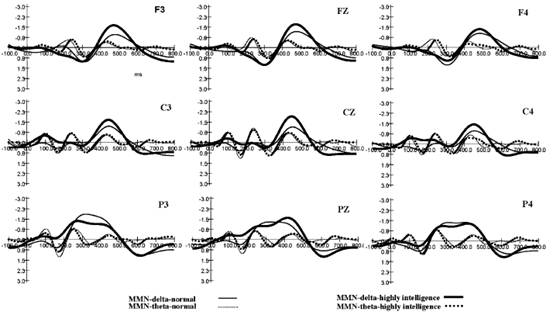
The research has been published on the SSCI journal: Liu T., Shi J, Zhao D, Yang J. The event-related low frequency activity of highly and average intelligent children. High Ability Studies, 2008,19(2): 131-139.
|