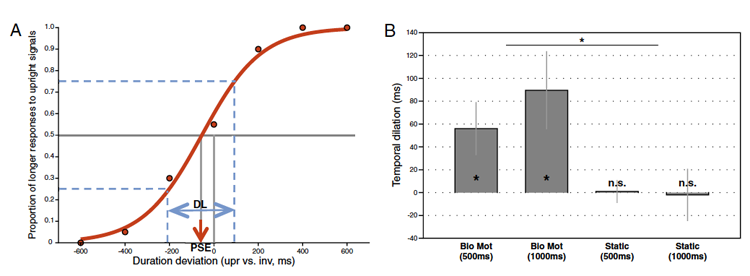
Timing visual events over fine scales is crucial for a range of everyday human activities, especially for interactions with other individuals. In spite of its theoretical importance, the brain mechanism underlying the experience of time and the timing of action remain obscure. By using a duration discrimination paradigm, Dr. Jiang Yi and his colleague in the Key Laboratory of Mental Health at the Institute of Psychology, Chinese Academy of Sciences demonstrated a novel temporal dilation effect specifically linked with biological motion signals. It was found that an upright biological motion sequence was perceived significantly longer than an inverted but otherwise identical sequence of the same duration. More importantly, the temporal dilation effect persisted even when the global configurations of the motion signals were spatially scrambled and observers were not explicitly aware of their biological nature. These findings suggest that the temporal encoding of biological motion relies upon a specialized brain mechanism tuned to life motion signals irrespective of their configurations, and is essentially an automatic process intrinsic to the human visual system, which may have evolved to facilitate social interactions and thereby environmental adaptation.
This research was supported by grants from the National Basic Research Program of China, the National Key Technology R&D Program of China, the National Natural Science Foundation of China, and the Key Laboratory of Mental Health, Institute of Psychology, Chinese Academy of Sciences.
This study has been published online before print in Proceedings of the National Academy of Sciences of the United States of America (PNAS) on January 3, 2012.
Wang, L., & Jiang, Y. (2012). Life motion signals lengthen perceived temporal duration. PNAS, doi: 10.1073/pnas.1115515109.