Trust is the psychological pillar that sustains human cooperation and the functioning of society. Therefore, there is wide interest in understanding what types of environment could foster interpersonal trust. Social psychologists have revealed the power of microenvironments (e.g., relational distance [close-distant] between two persons); for instance, we tend to trust close others (e.g., family members) more than distant others (e.g., strangers). Besides, economists, sociologists, political scientists, and cultural psychologists have revealed the power of macroenvironments (e.g., human ecology comprised of cultural norms, socioeconomic institutions, ecological conditions, and so forth); for example, people from individualistic countries tend to trust strangers more than do people from collectivistic countries.
Previous research, however, has largely overlooked the potential interplay between the microenvironment of relational distance and the macroenvironment of human ecology; for instance, unlike trusting strangers, trusting close others may have similar adaptive values pan-culturally. While some studies have found preliminary evidence for this micro-macro interaction, their findings are not robust and may suffer from many methodological limitations including a lack of diverse cultural samples and methodologies. To tackle the puzzle of whether the micro-macro interplay widely exists and how it operates, Drs. JING Yiming and CAI Huajian of the Institute of Psychology, Chinese Academy of Sciences (IPCAS), along with their international collaborators, conducted 4 studies to compare the levels of trust across relational distances (i.e., close, intermediate, and distant) and various types of human ecology simultaneously, and across and within national boundaries (e.g., Study 3 across 77 countries and Study 4 across 28 provinces in Mainland China), using a diverse range of analytic tools (e.g., a meta-analytic review, the multilevel analysis, etc.).
The findings identified a converging pattern of the micro-macro interaction: first, while people around the world all tended to trust close others more than distant others, this effect of relational distance was stronger in regions with more restrictive ecocultural features (i.e., higher societal collectivism, underdeveloped socioeconomic institutions, and more demanding climates). Second, although attitudinal trust (i.e., the reported trusting attitude) of distant others was lower in regions embedded within more restrictive human ecology, such differences often became negligible when coming to trusting close others (Figure 1 and Figure 2). These results demonstrate that interpersonal trust varies as a function of both micro and macro contexts, highlighting the need for adopting a micro-macro interactionist framework to unpack ecocultural variation in how people trust other persons.
This work entitled “Levels of Interpersonal Trust Across Different Types of Environment: The Micro-Macro Interplay Between Relational Distance and Human Ecology” has been published in the Journal of Experimental Psychology: General. This research was supported by the National Natural Science Foundation of China, the Major Project of the National Social Science Foundation, and the Young Talent Research Startup Fund Project of the Institute of Psychology.
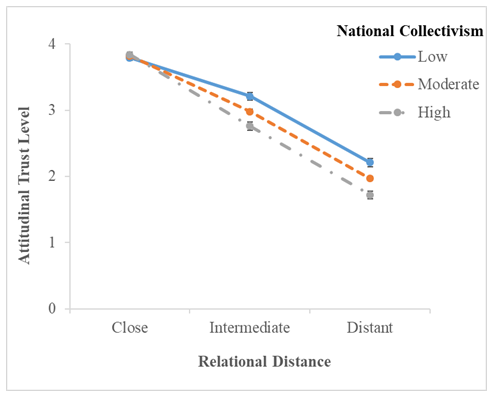
Figure1.Relational Distance Interacts with National Collectivism to Affect Levels of Attitudinal Trust across 77 Countries.
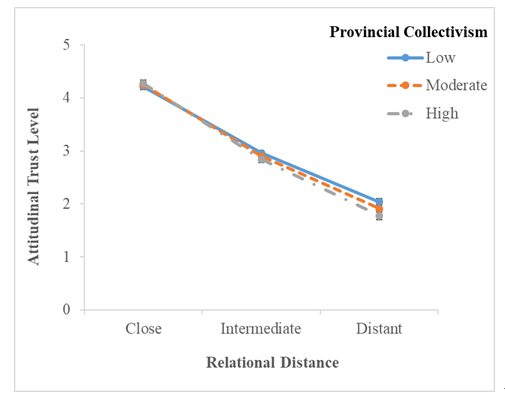
Figure 2. Relational Distance Interacts with Provincial Collectivism to Affect Levels of Attitudinal Trust across 28 Provinces in Mainland China. Image by JING Yiming.
CONTACT:
LIU Chen
Institute of Psychology
Chinese Academy of Sciences
Beijing 100101, China.
E-mail: liuc@psych.ac.cn