In classroom settings, children and adolescents are frequently required to follow sequential oral instructions from teachers, such as "Open your workbook, turn to page five, locate question three, and write down your solution on the answer sheet." Remembering and carrying out these multi-step verbal instructions heavily relies on working memory—the capacity to encode, retain, and manipulate information within a short period. Previous studies have shown that children with limited working memory capacity often struggle to follow teachers’ directions, which impairs their academic performance. Recent evidence indicates that including additional action-based encodings can enhance memory performance for spoken instructions. However, few studies have compared the facilitative effects and underlying mechanisms of different types of action-based coding.
To address this research question, a team led by Dr. YANG Tianxiao from the Laboratory of Neuropsychology and Applied Cognitive Neuroscience at the Institute of Psychology, Chinese Academy of Sciences, together with collaborators from the University of Leeds in the UK, systematically examined how various forms of action-based encoding techniques boost memory for spoken instructions among school-age children and adolescents.
The study consisted of two experiments. Experiment 1 recruited 39 children aged 8–9 years, tested with spoken instruction sequences comprising 2, 3, or 4 actions. Experiment 2 involved 40 adolescents aged 12–14 years, who were presented with fixed-length sequences of 4 actions. Both experiments adopted an instruction task (Figure 1). Each instructional sequence consisted of multiple action-object pairs. After hearing each pair, participants performed one of four coding tasks according to the experimental condition: verbal rehearsal, motor imagery, action observation, or self-enactment. Once the instruction sequence ended, participants recalled the entire instruction in order either by oral repetition or physical enactment.
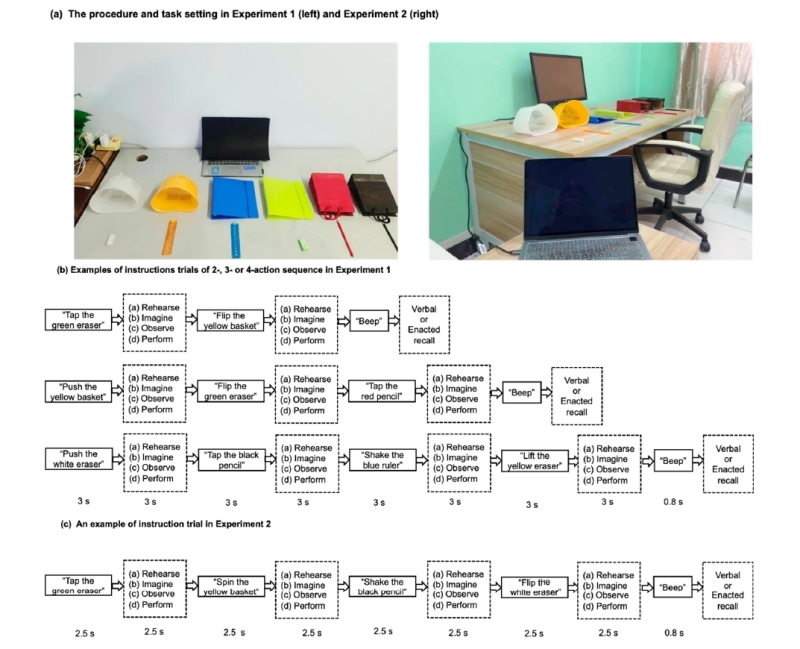
Figure 1 Display of objects in instruction task and procedure of instructional trial. Image by Dr. YANG Tianxiao.
The results revealed that both children and adolescents benefit from action-based encoding process (Figure 2). Compared with verbal rehearsal, three types of action -based encoding—motor imagery, action observation, and self-enactment—significantly improved performance in instruction memory. For children, the facilitative effects of action observation and self-enactment were more robust, whereas the effect of action imagery was relatively weak. This may be attributable to children’s immature motor imagery capacity. Among adolescents, the three action-based encoding techniques yielded significant facilitative effects with comparable effect sizes, implying the quality of memory representations constructed via action imagery in adolescents may have reached a level equivalent to that generated by action observation and physical enactment.
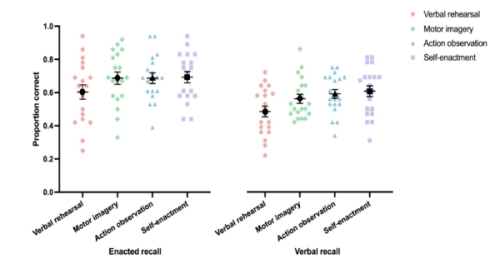
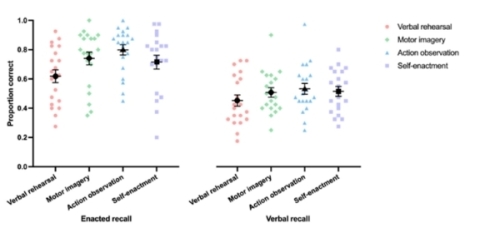
Figure 2. Performance of instruction following as functions of encoding technique and recall modality in children (upper panel) and adolescents (lower panel). Image by Dr. YANG Tianxiao.
Further analyses revealed that the serial position effect of the action-based encoding advantage was influenced both by the type of encoding technique and recall modality. As illustrated in Figure 3, under oral recall, action imagery and action observation produced greater facilitation for first items in the instruction sequence, whereas self-enactment mainly benefit recency items at the sequence end. By contrast, the three action-based encoding conditions exhibited similar serial position patterns under enacted recall. These findings suggest that despite comparable overall effect sizes, distinct cognitive mechanisms underpin different action-based encoding strategies.
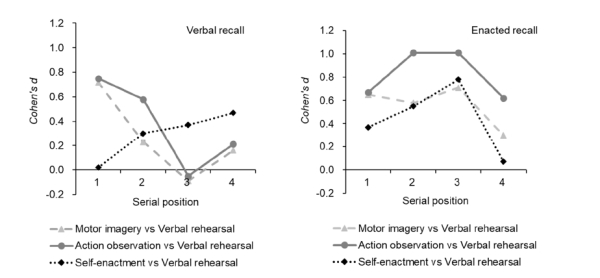
Figure 3 The serial position curves of action-based advantages relative to verbal rehearsal in adolescents. Image by Dr. YANG Tianxiao.
The present study compared similarities and differences among different action-based encoding techniques in terms of facilitative effects and cognitive mechanisms, extending the encoding-based action advantages from long-term memory to the domain of working memory, and offered meaningful implications for educational practice.When delivering multi-step oral instructions during lessons, teachers can encourage students to adopt action imagery, action observation and self-enactment strategy to retain instructional information and improve learning outcomes. Educators should also take developmental characteristics into account. For 8–9-year-old primary school students, action observation and self-enactment yield more consistent memory benefits. For adolescents, however, the three action-based encoding strategies produce equivalent effects, allowing teachers to select approaches flexibly according to classroom contexts.
This research was supported by the National Social Science Fund of China and State Key Laboratory of Cognitive Science and Mental Health, Institute of Psychology, Chinese Academy of Sciences,
The paper entitled "Action-based encoding improves instruction following in children and adolescents" was published in Behavioral Sciences. Co-first authors include YAO Zhaotong and SU Xiaomin (alumnus), while ZHAO Yuxi is an additional author from the Institute of Psychology, Chinese Academy of Sciences. Dr. YANG Tianxiao is the corresponding author. Professors Richard J. Allen and Amanda H. Waterman from the University of Leeds, UK also made significant contributions to this study.
Related paper:
Yang, T.-x.*, Allen, R. J., Waterman, A. H., Graham, A. J., Su, X.-m., & Gao, Y. (2024). Exploring techniques for encoding spoken instructions in working memory: a comparison of verbal rehearsal, motor imagery, self-enactment and action observation. Memory, 32(1), 41-54.